
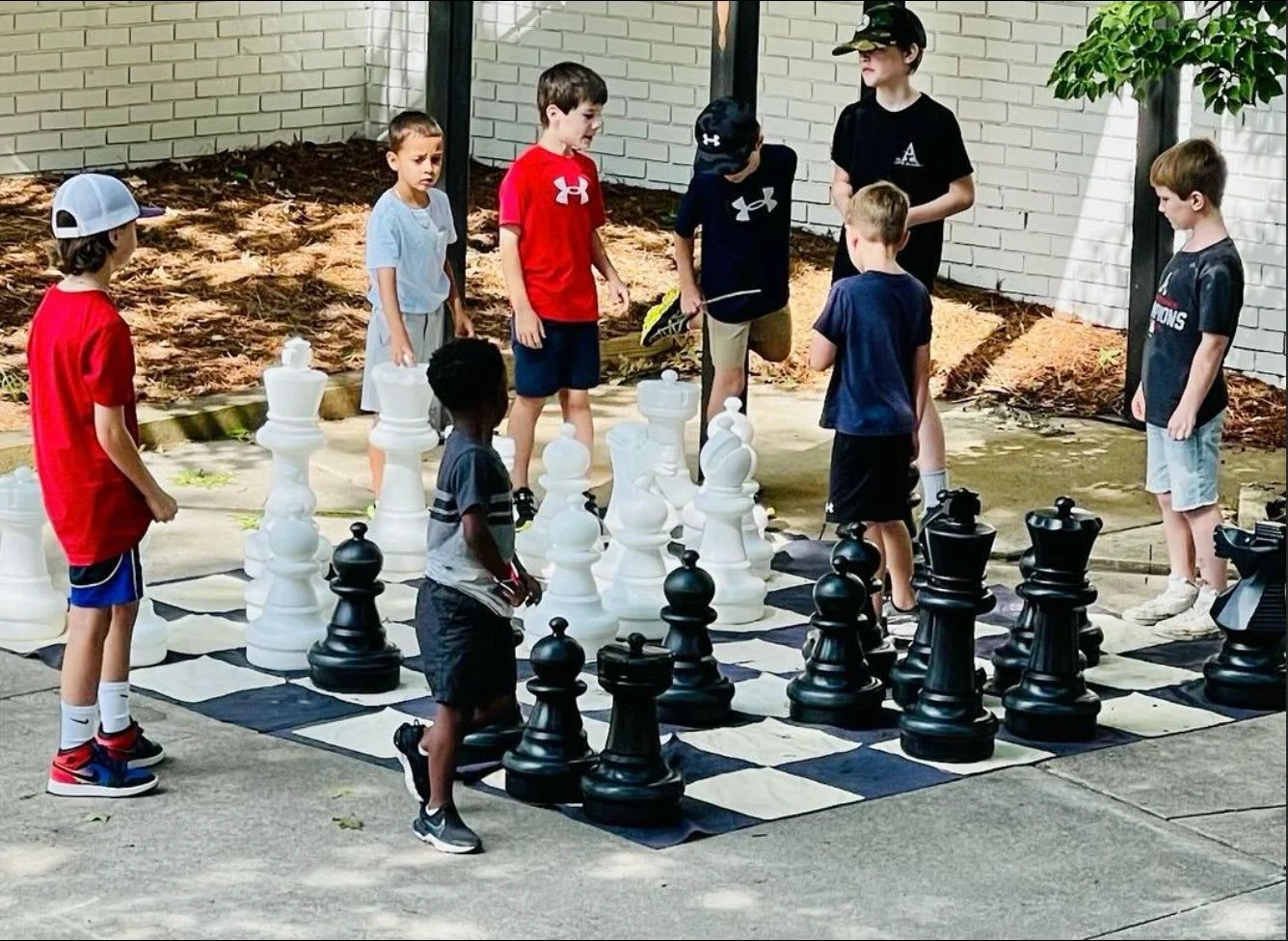
The strongest grant proposal ideas for schools connect a physical resource, such as a giant chess set, to outcomes that a funder already cares about: math achievement, physical activity, and social-emotional growth. Funders don't fund equipment. They fund results. That single shift in framing is what separates a proposal that gets read closely from one that gets skimmed and declined.
This guide walks through over 40 fundable project ideas, a step-by-step framework for turning an idea into a funded proposal, and why a giant chess set stands out as one of the most beneficial and fundable options on the list.
What Makes a Grant Proposal Idea Actually Fundable
Reviewers move through hundreds of applications a cycle, and they're pattern-matching for the same handful of signals every time.
A Specific, Countable Number of Students Served
"Improves student wellness" loses to "450 students will use this daily during recess and PE." Reviewers can't fund a feeling; they need a number they can picture and defend to their own board.
Language Lifted From the Funder's Own Priorities
If a funder's site says STEM, equity, or wellness, those exact words should appear in your case, not synonyms for them. Reviewers are often scoring against a checklist built from their own published language, and matching it directly makes their job easier.
Proof the Project Is Already in Motion
Funds already raised, a committee in place, and a vendor quote in hand all signal momentum a funder can back with confidence. Proposals that read as fully hypothetical are a harder yes than ones that show a project already underway.
A Clear Plan for Life After the Grant
Sustainability sections are where many otherwise strong proposals go quiet. A brief, concrete answer, such as a replacement fund, a recurring sponsor, or a student-leader pipeline, reassures reviewers they aren't funding a one-time expense they'll be asked to cover again next year.
40+ Grant Proposal Ideas for Schools This Year
Strong school grant funding requests tend to cluster around six areas funders already prioritize. Pick one or two that fit your campus rather than trying to cover all of them in a single request.
STEM and Math Enrichment
-
Robotics or coding club starter kits
-
A maker space with basic tools and 3D printing
-
STEM education grant funding for a portable science lab cart
-
Logic and problem-solving programs (chess-style strategy games count here; funders in this category respond well to activities with a measurable cognitive-skills tie-in)
-
Math manipulative sets for hands-on instruction
-
A campus weather station tied to science curriculum
Literacy and Reading
-
Classroom library expansion, especially diverse or bilingual titles
-
A read-a-thon paired with a physical reward like new outdoor equipment
-
Literacy intervention grant proposals for small-group tutoring materials
-
A "book vending machine" or reading-incentive program
-
Author visit or writer-in-residence programs
-
Take-home book bags for early readers
Outdoor Learning and Active Play

-
School garden grant proposals for raised beds and an outdoor classroom
-
A shaded outdoor learning pavilion
-
Playground equipment upgrades that meet accessibility standards
-
A giant chess set installation for recess and PE; funders in the STEM, wellness, and outdoor-classroom categories all respond to this because it doubles as active play and cognitive skill-building in one piece of equipment
-
Outdoor fitness stations or a walking track
-
Nature trail or sensory garden
Social-Emotional Learning and Wellness
-
Counselor-led SEL curriculum materials
-
Peer mediation or student leadership training programs
-
Sensory rooms for students who need a regulation space
-
Recess activation programs that reduce discipline referrals
-
Mindfulness or movement breaks curriculum
-
Mental health first-aid training for staff
Arts and Enrichment
-
Musical instrument replacement or expansion
-
Art supply grants for elementary programs
-
Theater or drama program startup funding
-
Mural or public art projects with student involvement
-
Dance or movement program equipment
-
Photography or digital media club equipment
Technology and Digital Access
-
Classroom tablet or Chromebook carts
-
Assistive technology for students with disabilities
-
Digital literacy curriculum for younger grades
-
Internet hotspot lending programs for families without home access
-
Interactive whiteboard replacements
-
Coding curriculum licenses
Family and Community Engagement
-
Multilingual family communication programs
-
Family literacy or math nights
-
Community garden partnerships
-
After-school program transportation
-
Cultural heritage celebration events
-
Volunteer grandparent or mentor programs
How to Write a Strong Grant Application: A Step-by-Step Framework
Once you've picked a project, the writing process matters as much as the idea itself. Here's a framework that works whether you're applying to a $500 district micro-grant or a $10,000 community foundation award.
Week 1: Define the Project
Get the right people in a room, such as a teacher, a counselor or SEL lead, and whoever's leading the PTA effort, for one short meeting. Walk out with three to five goals across academic, wellness, and family-engagement lines, plus photos of the proposed location if it's a physical installation.
Week 2: Build a Prospect List
Don't write one application at a time. Build a tracker of 15–20 potential funders with their deadlines and award ranges so that you can reuse the same core narrative across several.
Weeks 3–4: Draft the Proposal:
This is where most of your writing time should go. Confirm your budget and get a real vendor quote; vague numbers are one of the fastest ways to get declined. Draft how you'll measure results before you submit, not after.
Week 5: Finalize and Submit
Edit for jargon, match the funder's own language where you can, and double-check every required attachment: budget, letters of support, quotes, timeline.
Week 6 and Beyond
Follow up. Send a short thank-you to the program officer regardless of outcome. If declined, ask for feedback and reapply in the next cycle; a polite request for feedback is one of the most underused steps in the process.
Why Giant Chess Sets Are a Strong Grant Proposal Idea

Giant chess sets check a rare combination of boxes for reviewers: low ongoing cost, daily visible use, and a legitimate tie to more than one funding priority at once. A single installation covers several funding angles simultaneously:
-
STEM appeal: Logic and problem-solving skills give the project a legitimate cognitive-skills angle.
-
Wellness appeal: Active outdoor play supports physical activity and time away from screens.
-
SEL appeal: Turn-taking, patience, and sportsmanship build social-emotional skills through everyday play.
That diversity means the same project can be pitched to a STEM funder, a wellness funder, or an outdoor-classroom funder without changing the core case.
Reviewers also respond well to durability. A quality outdoor set is built to withstand weather and heavy daily handling, so it reads as a one-time investment rather than a recurring ask, which is exactly the kind of project funders prefer to back. It's the same visible, community-facing appeal that recently caught the attention of the Akron Beacon Journal, which featured MegaChess and its giant sets in local communities.
There's honest nuance worth including in the proposal itself. Research on chess-based programs shows real but modest cognitive benefits, and the effect is strongest with consistent use, roughly a school year's worth of regular play, rather than a one-time installation that sits unused. Stating that plainly, rather than overselling it, tends to build more credibility with reviewers than an inflated claim would.
What a Giant Chess Set Budget Looks Like
Funders respond to real numbers, not round estimates, so it helps to know what similar school projects have actually cost before writing the budget section. Costs generally scale with three things: king size, board material, and whether installation is included.
-
Starter installation: A 25-inch king set paired with a safety-edge board runs close to $1,200 for the set and board alone, with the remaining budget covering delivery and signage.
-
Mid-size outdoor set: A 49-inch king paired with a hard-plastic board lands closer to $2,500 for the set and board, with the rest of a typical $5,000 project covering freight, a pad, and installation.
-
Premium installation: A 38-inch Perfect set paired with a rubberized vinyl board runs closer to $5,900 for the set and board, with the remaining budget in a $10,000-scale project going toward a finished concrete pad and signage.
A practical budgeting tip worth including in the proposal itself is to get a real vendor quote first, including delivery and any pad or signage work, then set the funding goal about 10% above that number. Coming in over goal is a minor win; coming in under is a delay.
One line to keep consistent across the budget and the narrative: giant chess boards are sold separately from the pieces, so both need their own line item in the vendor quote a reviewer will expect to see.
Choosing a Partner for Your Grant-Funded Project
Whichever project makes the shortlist, funders respond best to proposals that already include a real vendor and a real quote. That's where MegaChess comes in. As the seller of giant chess sets to schools, parks, and municipalities nationwide, MegaChess can provide the specific, itemized figure a reviewer needs to see, along with sizing guidance so the installation actually fits your space and student count.
Purchase one of our giant chess sets or browse our site to see our full selection before you finalize your budget section.
Frequently Asked Questions
What are the easiest school grant proposal ideas to get funded?
Projects with a low per-student cost and visible daily use tend to get funded fastest, such as outdoor play equipment, classroom library expansions, and SEL materials. These serve every grade at once, which makes the impact easy for a reviewer to picture.
How much does a school grant proposal typically need to request?
Most campus-level school grants range from $500 to $15,000 depending on the funder and project scope. Smaller micro-grants from district foundations tend to fall on the lower end, while community foundation and STEM-specific grants can fund larger installations.
How long does it take to write a school grant proposal?
Plan for four to six weeks from idea to submission using a repeatable framework. That includes time to define the project, build a list of funders, draft the narrative, and obtain a real vendor quote.
Do giant chess sets qualify for school grant funding?
Yes. Giant chess sets are commonly funded through STEM, wellness, and outdoor-classroom grant categories because they combine active play with measurable cognitive-skills benefits. Framing the project around student outcomes, rather than the equipment itself, is what makes it fundable.