
Critical thinking activities for students are exercises that train kids to question assumptions, weigh evidence, and reach their own conclusions instead of guessing or repeating what they heard. The best ones don’t feel like schoolwork. They feel like games, debates, or puzzles, and that’s exactly why they work.
Why Critical Thinking Skills Matter for Students
Teachers and parents keep hearing that students need to think critically, but the skill rarely develops on its own. It has to be practiced like a muscle. A 2024 study in the Siirt Journal of Education followed 159 students in grades 5 through 7 and found that students who had spent two or more years playing competitive chess scored noticeably higher on a standardized critical thinking scale than students who hadn’t. Researcher Feyzullah Şahin pointed to the game’s built-in habit of weighing options and consequences before acting as the likely reason. That same logic applies to any activity that forces a pause between idea and action. The longer a student has to justify a choice, the sharper their thinking gets.
Top 7 Critical Thinking Activities for Students
Each one targets a different habit like questioning, sorting evidence, arguing a side, observing before judging, finding connections, defending a choice, and pausing before a move, and works just as well in a classroom, a living room, or a line at the grocery store.
The Why Chain
Ask a student to explain something, then ask why about their answer, then why again. After four or five rounds, most students hit bedrock: an assumption they’ve never had to defend before. It needs no materials and works on any topic, from history class to lunchroom rules.
Fact vs. Opinion Sort
Hand students a mixed list of statements and have them sort each into fact or opinion, then defend the harder calls out loud. This builds the habit of checking a claim before accepting it.
Two-Sided Debate
Assign students a position they don’t actually hold and have them argue it anyway. Arguing a side you disagree with forces real engagement with the other side’s reasoning, not a weakened version.
Mystery Object Observation
Put an object in a box or bag. Students describe only what they can observe, like its weight, texture, and sound, before guessing what it is. Separating observation from guesswork is a skill most adults still struggle with.
Compare and Contrast Challenge
Give students two things that seem unrelated, like a leaf and a circuit board, and ask them to find three real similarities. The stretch is where the thinking happens.
Build-and-Defend Challenge
Students build something with limited supplies like blocks, cards, or tape, to meet a constraint, then explain the trade-offs behind every design choice they made.
Strategy Games With a Pause Rule
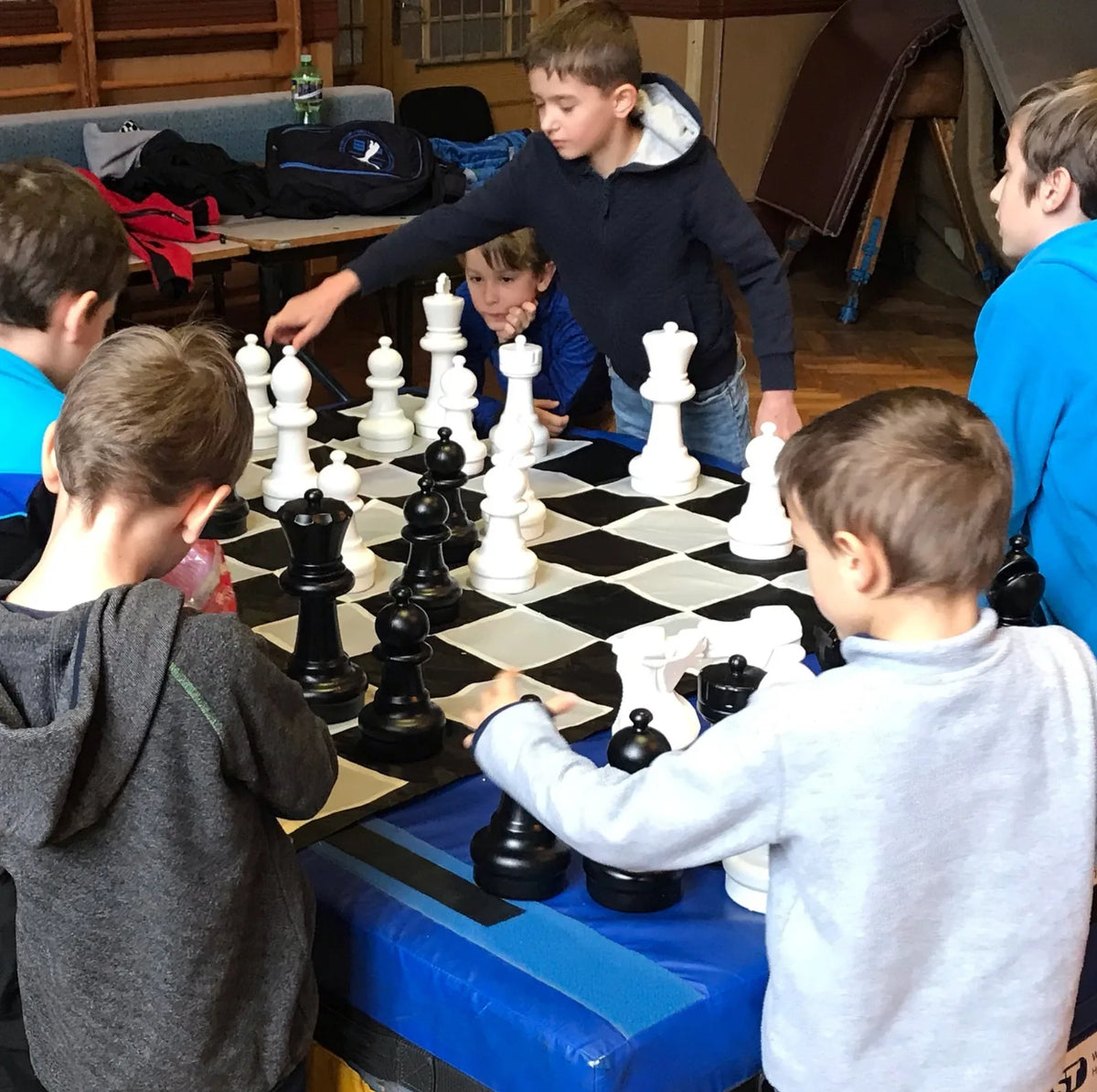
Any game where a player has to plan several moves ahead works here, but the pause rule matters most. Before each move, the player says out loud what they’re trying to accomplish and what could go wrong. Giant chess sets are built for exactly this kind of practice.
The Cognitive Benefits of Chess and Why Bigger Boards Work Better

Decades of research tie chess to measurable gains in planning, working memory, concentration, and pattern recognition; the same mental muscles behind every activity on this list. That skill doesn’t come from knowing the rules. It comes from the forced pause before each move, where a player has to hold several possible outcomes in mind before committing to one.
Playing that version at giant scale adds something a tabletop set can’t: a shared field of vision. When the pieces are waist-high, and the board covers the floor, the player isn’t the only one tracking the position. The group around them sees the same threats and openings in real time, out loud, instead of peeking over a shoulder at a placemat-sized board. That turns one student’s private reasoning into a conversation the whole room can follow, question, or build on, which is exactly the kind of modeling that makes a critical thinking skill transfer outside the game itself.
Where MegaChess Fits Into the Picture
MegaChess, a leading seller of giant chess sets, has spent nearly two decades supplying giant chess sets to schools, libraries, and after-school programs, and the pattern shows up again and again: once a set is in a classroom, kids who’d normally tune out a worksheet will stand over a life-size board for twenty minutes, arguing about a move. That’s not a coincidence. A giant chess set forces the same pause-and-explain habit covered above, just at a scale where the whole group can watch it happen and jump in.
Educators notice this too, which is why most giant chess installations at schools get funded by a PTA or PTO building a grant case rather than the district budget. We put together a funding playbook for exactly that, covering more than 50 ways to raise the money and where to find grant sources that back projects built around critical thinking and inclusion.
Put This Into Practice Today
These seven activities only build the habit if students actually practice them, so buy one of our giant chess sets or browse our full selection to find the size that fits your classroom, library, or backyard, and start running them this week instead of filing them away for later.
FAQs About Critical Thinking Activities
How can you tell if a critical thinking activity is actually working?
Look for process, not just the right answer. A student who explains their reasoning, catches their own mistake mid-sentence, or changes their mind after hearing a counterargument is showing the skill working in real time. A correct guess with no reasoning behind it isn’t the same thing, even if the answer sheet says it is.
Do these activities work for students who struggle with reading or writing?
Most of them do, since the thinking happens out loud rather than on paper. The Why Chain, Two-Sided Debate, and Mystery Object Observation all run on conversation, not composition, which makes them a good fit for students who think clearly but freeze up in front of a blank page.
Can these activities be adapted for one child instead of a group?
Yes, with small adjustments. The Why Chain and Compare and Contrast Challenge work the same solo. For activities built around two sides, like the Two-Sided Debate or a game of giant chess, an adult or sibling can take the other role, which often works better anyway, since the student isn’t performing for peers.
Is critical thinking the same thing as creative thinking?
No, and mixing the two up is a common mistake. Creative thinking generates options; critical thinking evaluates them. A student brainstorming ten solutions to a problem is thinking creatively. A student figuring out which of those ten actually holds up is thinking critically. Most real problems need both, in that order.